
Audio and Words: Why We Love Using Sounds
In a world saturated with text—from endless Slack notifications to sprawling social media threads—human communication is undergoing a seismic, sonic shift. We are witnessing the rise of a new digital dialect where a well-timed “Oof,” a dramatic vine thud, or a haunting melody speaks louder than a thousand characters. This phenomenon isn’t just a trend; it’s rooted in our biology.
In this exploration, we dive into the core of Audio and Words: Why We Love Using Sounds and how this shift is redefining our digital identity.
1. The Sonic Shift: Why Text is No Longer Enough
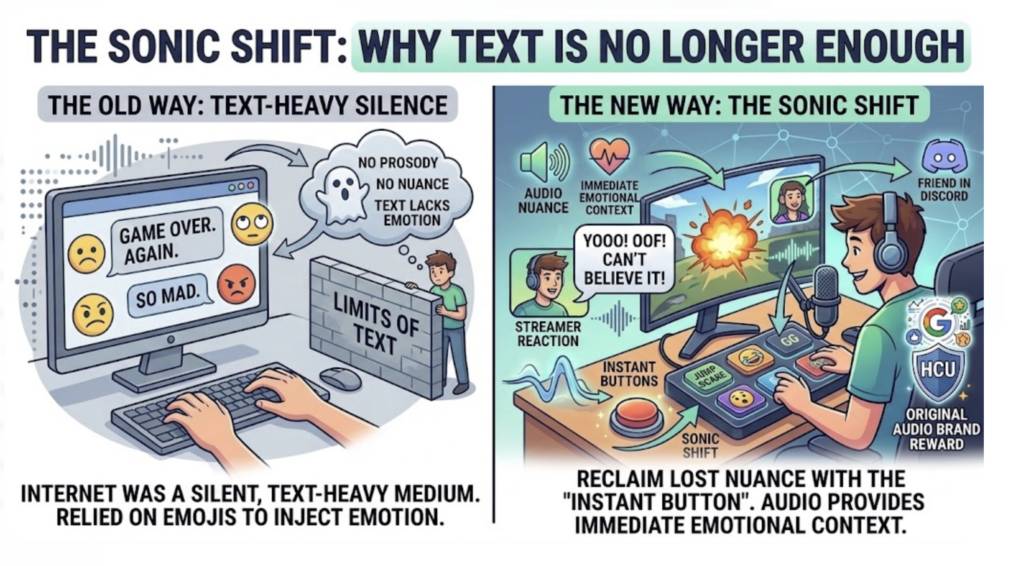
For decades, the internet was a silent, text-heavy medium. We relied on emojis to inject emotion into flat sentences. However, as high-speed internet and mobile gaming became ubiquitous, the limitations of text became glaringly obvious. Text lacks “prosody”—the patterns of stress and intonation in a voice that tell us if someone is joking, angry, or excited.
This is where the “Instant Button” comes in. By using a soundboard, we reclaim that lost nuance. Whether you are a streamer reacting to a jump scare or a friend in a Discord call, audio provides an immediate emotional context that text simply cannot replicate.
2. The Psychology of Sound vs. Text
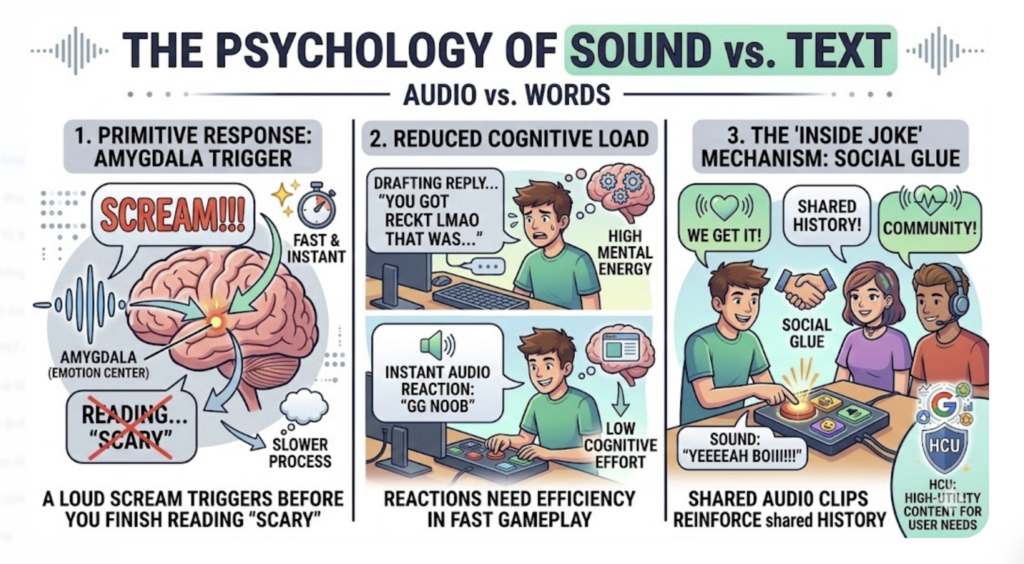
To understand Audio and Words: Why We Love Using Sounds, we have to look at how our brains process information. According to audiology research, the human brain processes auditory information faster than visual text.
Primitive Response: Sound triggers the amygdala—the part of the brain responsible for emotions—almost instantaneously. A loud “scream” sound effect initiates a physiological response before your brain even finishes “reading” the word “scary.”
Reduced Cognitive Load: Choosing an audio reaction requires less mental energy than drafting a reply. In a fast-paced environment like a competitive gaming match, efficiency is king.
The “Inside Joke” Mechanism: Sound functions as a social glue. When a community uses a specific audio clip, it reinforces a shared history. It’s a way of saying, “I understand this reference, and I know you do too.”
3. Creating Atmosphere: The Power of Nostalgia
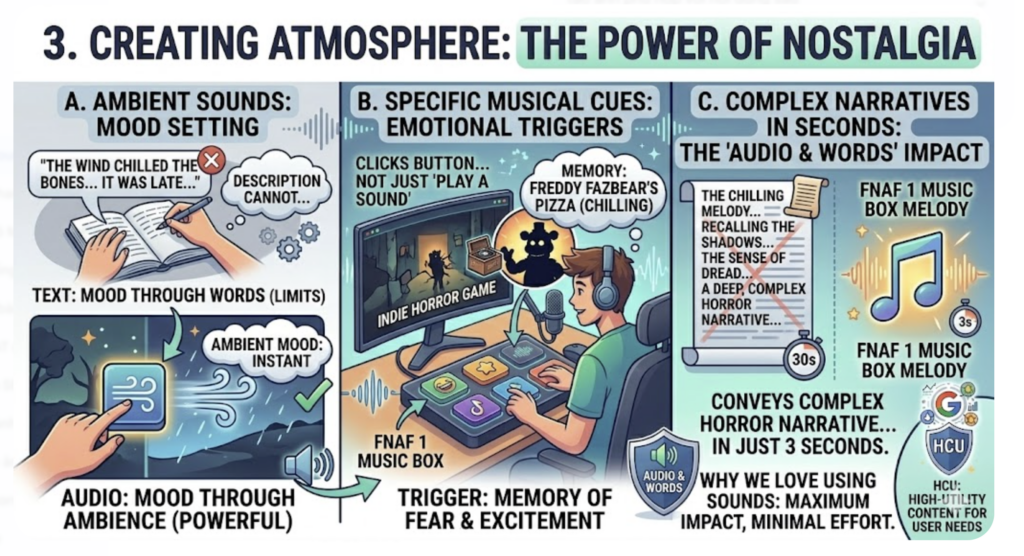
One of the most compelling reasons we prefer sounds over words is their ability to transport us. Ambient sounds and specific musical cues can set a mood in a way that descriptions cannot.
Take, for example, the chilling atmosphere of indie horror games. Fans often use a FNAF 1 Music Box soundboard to instantly recreate the tension of Freddy Fazbear’s Pizza. Clicking that button doesn’t just “play a sound”; it triggers a specific memory of fear and excitement. This is a prime example of Audio and Words: Why We Love Using Sounds—the music box melody conveys a complex “horror” narrative in just three seconds, something that would take a paragraph of text to describe.
4. How to Create “Helpful” Audio Content (HCU Guidelines)
Google’s Helpful Content Update (HCU) prioritizes content that provides a satisfying, original experience for users. To align with Google’s Search Essentials, you must go beyond “low-effort” automation:
A. Provide Unique Context
Don’t just host a sound file; explain why and when to use it. A high-utility page doesn’t just give you a button; it tells you that a specific sound is perfect for “ironic fails” or “clutch gaming moments.”
B. Originality and Curation
Avoid mass-producing thousands of low-quality clips. Instead, curate “Audio Brands.” Google rewards expertise. If you can explain the cultural origin of a meme sound and provide a high-quality, noise-filtered version of it, you are providing “Added Value” that generic sites lack.
C. Technical Excellence (UX)
In the world of Audio and Words: Why We Love Using Sounds, latency is the enemy. A soundboard is only helpful if the audio plays the microsecond it is clicked. Ensure your files are optimized (OGG or MP3) to balance quality with loading speed.
5. Sound as a Personal Brand
In the 2026 digital economy, your “voice” isn’t just what you say—it’s what you play. Top-tier creators have “Sonic Logos.” Think of the specific chime when a streamer gets a donation or the signature sound effect they use when they make a mistake.
Customizing your audio profile allows you to:
Stand Out: In a sea of generic creators, your unique soundboard makes you memorable.
Foster Community: When your audience starts using your signature sounds in their own chats, your brand has successfully gone viral.
Enhance Engagement: Interactive audio allows the audience to participate in the content creation process.
6. The Future: From Static Buttons to AI Synthesis
As we looked at in our previous discussion on the Meme Sound Future: How AI Voice Changes It, the line between audio and words is blurring further. We are entering an era where you can type a word and have it instantly spoken in a “meme voice.”
This evolution confirms the core thesis of Audio and Words: Why We Love Using Sounds: we are hungry for more expressive, more human, and more efficient ways to connect. Whether it’s a nostalgic music box melody or a generated AI joke, audio is the bridge that turns a cold digital interaction into a shared human experience.
Conclusion
The battle of Audio and Words: Why We Love Using Sounds isn’t about one replacing the other. It’s about synergy. Words provide the facts, but sounds provide the soul. By understanding the psychology behind our love for audio, and by following HCU principles to provide high-quality, original content, you can master the art of modern communication.